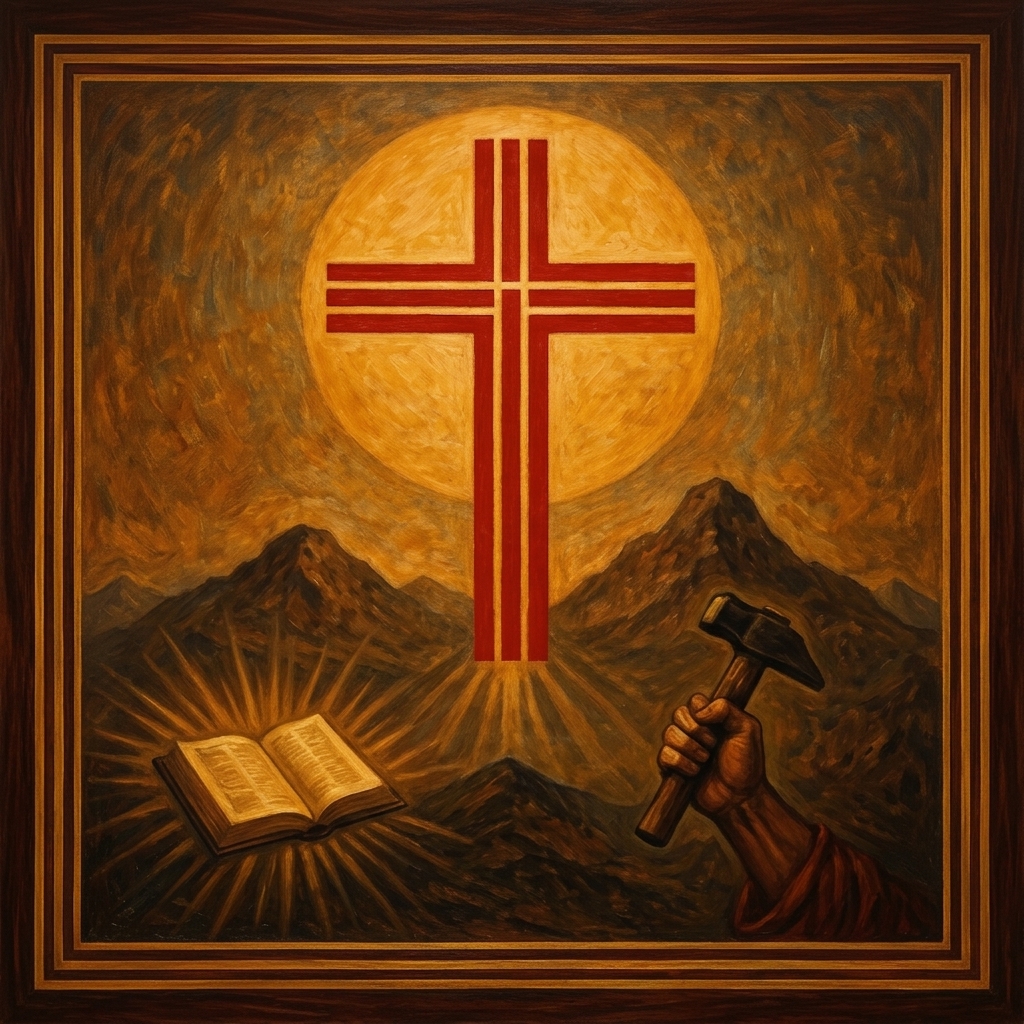
Forensic Exegesis: Logos (λόγος) as Historical Ratio and Community Structure
Mapping the historical and physical mechanics of Logos in 1st-century Koine Greek: how structural ratio and shared labor preserved working-class communities under imperial pressure.
Forensic Exegesis: Logos (λόγος)
Observational Baseline: Christians have defined their faith and theology for over two millennia. As an atheist electrician mapping the physical process, my role is not to argue metaphysics, invent a new theology, or tell believers what their religion "really" is. My objective is strictly forensic: to map the physical mechanisms embedded in scripture, observe how those mechanisms preserved working-class communities in history, and analyze why the underlying process still produces real-world return motion today.
1. Etymological & Historical Context
In modern translations of John 1:1, the Koine Greek word λόγος (logos) is typically translated as "the Word".
To understand how this text functioned for 1st-century readers, one must examine how the word logos operated in the daily trade, commerce, and philosophy of the Greco-Roman world.
Derived from the verb λέγω (lego — to gather, count, lay in order), logos was not primarily an abstract theological term. It was a practical, everyday working word:
- In Trade & Accounting: Logos was the financial ledger—the balance of debts, assets, and return motion in a business transaction.
- In Building & Craft: Logos was the mathematical ratio of a beam, the slope of a drainage channel, or the structural proportion of a wall.
- In Civic Life: Logos was the coherent rationale or rule of law that allowed a city to function without collapsing into mob violence.
2. The Material Necessity of 1st-Century Communities
When the Gospel of John was written in the late 1st century AD, working-class people in the Roman Empire lived under immense physical strain:
- Heavy imperial taxation and debt slavery.
- High infant mortality and minimal public health infrastructure.
- Arbitrary violence from Roman occupation forces and local elites.
An isolated worker or peasant family facing these conditions had low odds of survival.
To endure, working people formed tight-knit communities (oikos) anchored by a shared structural ratio (Logos)—a common moral baseline of non-extractive mutual aid, honest trade, and unyielding covenant loyalty (pistis).
When John 1:14 states that "the Logos became flesh and pitched its tent among us" (), 1st-century working readers understood the physical outcome: the abstract ideal of solidarity had materialized into a living, physical community of people caring for one another's real needs.
3. Physical Mechanics & Historical Sediment
Analyzing the historical sediment reveals why Christian communities expanded rapidly across the Mediterranean basin despite severe Roman persecution:
- Physical Resource Pooling: The early Logos-aligned communities shared daily bread, cared for widows, buried the dead, and paid off debts for members in crisis (Acts 2:44–45).
- Plague Survival: During the Cyprian Plague (c. 250 AD), pagan elites fled cities, while Christian communities stayed behind to nurse both Christian and non-Christian sick. Their basic sanitary care reduced mortality by over 60%, resulting in higher biological survival rates for the community.
- Trust Infrastructure: Because members operated by a predictable ratio of honesty and accountability, trade between Christian communities across cities carried lower transaction costs and lower fraud risks than pagan merchant networks.
4. Observational Conclusions
Mapping the material process of Logos leads to clear empirical conclusions:
- Process vs. Metaphysics: Whether one believes in supernatural theology or views the world through pure physical materialism, the historical process remains identical. The physical mechanism—shared ratio, mutual accountability, and tangible moral labor—is what preserved human lives under load.
- The Endurance of the Mechanism: Christianity survived 2,000 years of historical upheaval not because of abstract debates, but because its underlying social technology consistently generated real-world trust, community continuity, and survival capital on the shop floor.
Examine the Full Text
For the complete forensic audit of scriptural mechanics and working-class history, read the master manuscript:
👉 Examine the Book on Amazon: Materialist Christianity by Ezra Byrd
Examine the Full Masterwork
This node is part of the broader physical and mechanical framework recorded in Materialist Christianity by Ezra Byrd.